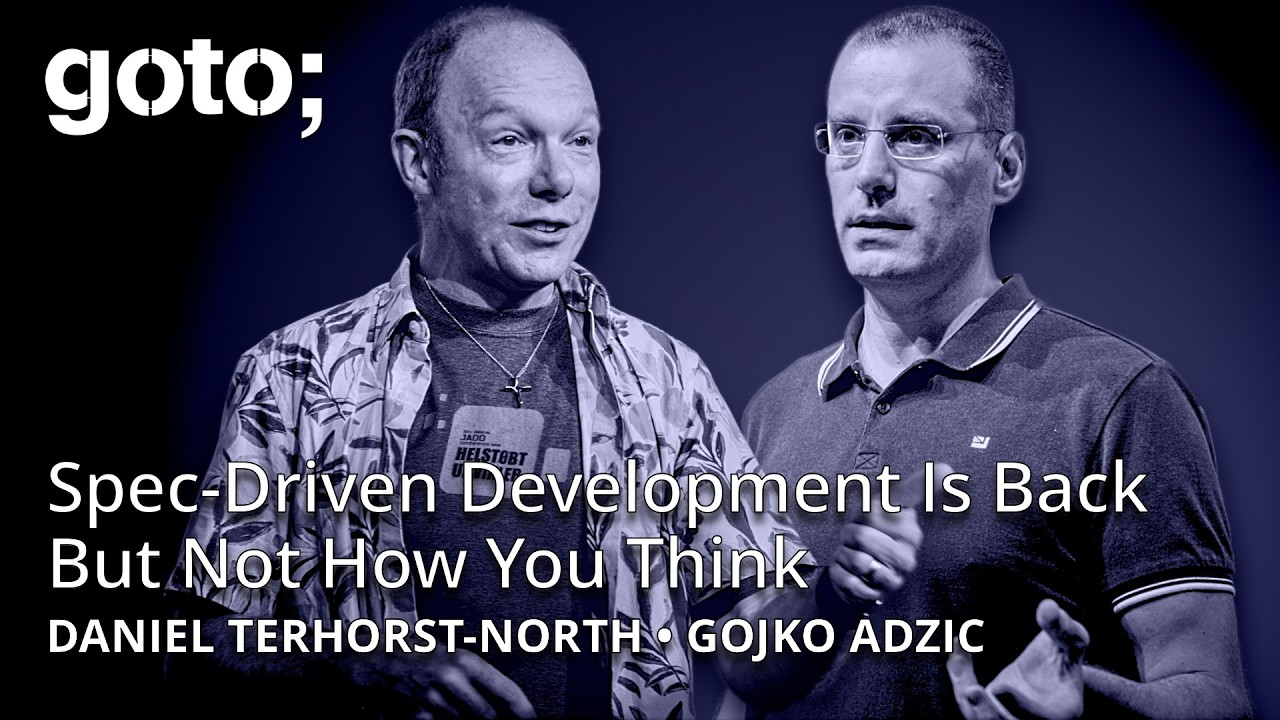
Spec-Driven Development Is Back. But Not How You Think
You need to be signed in to add a collection
Gojko Adzic and Daniel Terhorst-North tackle the question every software team is wrestling with right now: does AI-assisted development actually work, and if so, how? Their verdict is nuanced. One-shot "spec-to-product" approaches are doomed — both compare them to CASE tools and model-driven architecture of past decades, great for selling to enterprise buyers, disappointing in practice. What does work is tight, iterative feedback loops where AI handles the more deterministic, structural parts of the job while humans retain ownership of domain knowledge, semantic correctness, and architectural judgment. The most practically useful thread of the conversation is Gojko's insight on guardrails: instead of relying on markdown files and hoping your AI agent stays in line, encode your rules as real, automated linting checks — ones that run in CI, apply to humans and bots alike, and include actionable error messages. Daniel adds a complementary observation: AI shines brightest not on core domain code, but on the "quality of life" tasks that never quite make it to the backlog. Their shared conclusion is that the teams winning with AI right now are the ones treating published frameworks as starting templates to rapidly adapt — not gospel to follow blindly.
Transcript
Gojko Adzic and Daniel Terhorst-North tackle the question every software team is wrestling with right now: does AI-assisted development actually work, and if so, how?
Their verdict is nuanced. One-shot "spec-to-product" approaches are doomed — both compare them to CASE tools and model-driven architecture of past decades, great for selling to enterprise buyers, disappointing in practice. What does work is tight, iterative feedback loops where AI handles the more deterministic, structural parts of the job while humans retain ownership of domain knowledge, semantic correctness, and architectural judgment.
The most practically useful thread of the conversation is Gojko's insight on guardrails: instead of relying on markdown files and hoping your AI agent stays in line, encode your rules as real, automated linting checks — ones that run in CI, apply to humans and bots alike, and include actionable error messages.
Daniel adds a complementary observation: AI shines brightest not on core domain code, but on the "quality of life" tasks that never quite make it to the backlog. Their shared conclusion is that the teams winning with AI right now are the ones treating published frameworks as starting templates to rapidly adapt — not gospel to follow blindly.
About the speakers

Originator of Behavior Driven Development (BDD) & Principal at Dan North & Associates

Award-winning author and software delivery consultant