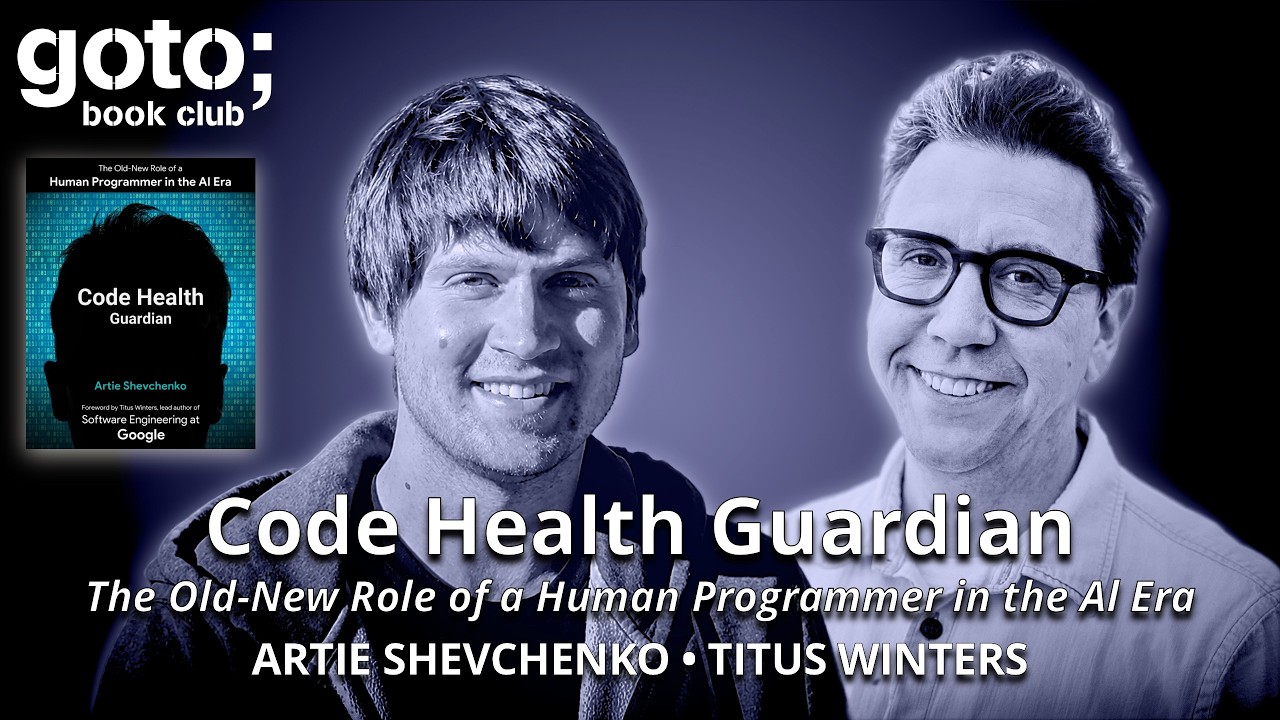
Code Health Guardian
You need to be signed in to add a collection
Millions of us will soon need to compete with AI. As it reshapes the tech industry, how will you ensure your skills remain indispensable?
Transcript
Artie Shevchenko, a former Google engineer who is now at Canva and teaches at ITMO University, tells Titus Winters how his book “Code Health Guardian” came together: the internal code review classes he built at Google (over 1,000 Googlers attended, with a 4.5-star rating), a talk on A Philosophy of Software Design, and years of teaching a university course. He keeps that book's three complexity problems (change amplification, cognitive load, and unknown unknowns), which he says help you rank what to fix first. But he doesn't agree with its two causes, obscurity and dependencies. Dependencies are also the building blocks of all software, so he replaces them with six more specific causes: untrue interfaces, complex interfaces, unfamiliarity, too many dependencies, duplication, and unstable dependencies. Titus agrees that "all dependencies are bad" misses the point, since every dependency is both a benefit and a liability.
The AI conversation turns on understanding. Artie compares models to two types of exam students who give nearly identical answers: one who understands the material and one who memorized it. Most of the time you can get away with the second kind, but not always, so a human "code health guardian" still has to validate AI output or risk losing intellectual control of the codebase. He admits he's still learning how to prioritize reviews, and no longer reads every test line as carefully. Titus adds that his top worry is whatever is hardest to change later (dependencies, frameworks, state storage, API design, database schemas), which lines up with Artie's view that interfaces sit at the top of the list. They also discuss intellectual versus statistical control (tests as evidence), and Artie makes the case for "semi-functional programming," meaning immutability by default, which reduces obscurity. Titus ties it to testing: stateless code is trivial to test, and mutable state is where time enters the problem. Both stress that nobody has the full playbook for AI-assisted development yet.
About the speakers

Titus Winters ( interviewer )
Senior Principal Scientist at Adobe & Co-Curator of "Software Engineering at Google"

Artie Shevchenko ( author )
Lecturer at ITMO University, author of Code Health Guardian, and ex-Googler