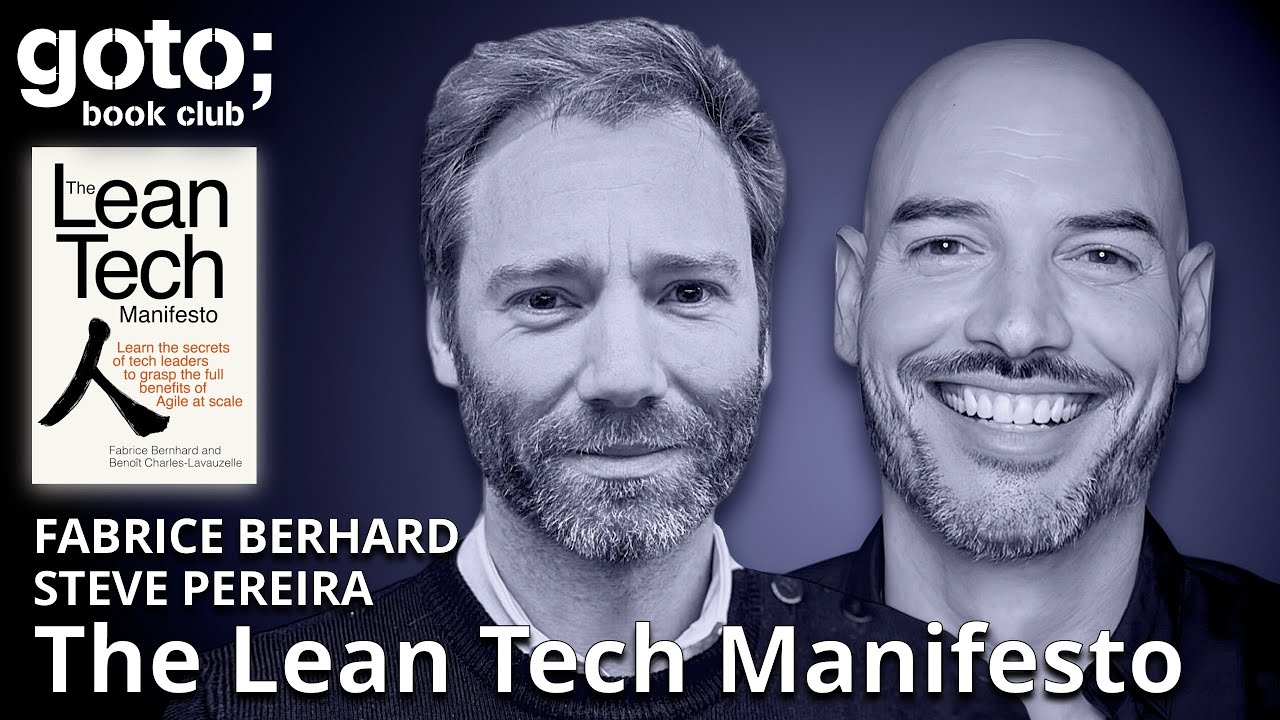
The Lean Tech Manifesto
You need to be signed in to add a collection
Steve Pereira interviews Fabrice Bernhard Bernhard on The Lean Tech Manifesto - scaling agile with lean principles while keeping humans at the center. A must-read for tech leaders.
Transcript
Introduction
Steve Pereira: Hello, everyone. Welcome to the GOTO Book Club. I'm Steve Pereira, your host. For this session I am joined by Fabrice Bernhard who is the co-author of the Lean Tech Manifesto. Welcome, Fabrice. You want to say a little bit about yourself? Just introduce yourself to the audience.
Fabrice Bernhard: Thank you so much for having me, Steve Pereira. I'm so happy to be interviewed by the co-author of Flow Engineering. My name is Fabrice Bernhard. I'm the co-founder of a company called Theodo. We're a tech consultancy. We want to be the value-driven tech consultancy. We're about 700 people now, in London and Paris and in Casablanca. I'm also the co-author of the Lean Tech Manifesto, which is the book where we share our experience scaling from 0 to 700 people and $100 million revenue while trying to stay agile, and how we use lean and tech to do that.
The Catalyst: When Agility Meets Its Limits
Steve Pereira: I think this is such a great topic. I'm really excited about this. Tell us first about the inspiration for the book. What initially got this going? What was the catalyst for writing the book?
Fabrice Bernhard: The origin story is actually quite telling. We were in our lean journey, trying to understand this lean body of knowledge to apply to our organization. Part of that was traveling to Japan to visit Toyota factories. We went on one of these study trips, and they involve quite a lot of transport.
We were on this bus and we're having a discussion about agility, and Mike Ballé, who's this amazing global award-winning lean expert, is arguing that agile doesn't really work at scale. I'm a passionate idealist. When we discovered agile, it really transformed the organization. So I'm trying to defend the fact that agile is amazing and there are organizations that have grown super fast and are still innovating at incredible speeds. They seem to have some form of agility despite being very big.
He takes the Agile Manifesto and tries to show me principle by principle, like these principles make sense in terms of capturing what makes an agile team great. But they don't really make sense if you have to lead hundreds or thousands of people. I had to agree that this is true when you look at the original document.
My counter argument was, but if it's just a matter of wording, I'm pretty sure that now that I've been on a lean journey for a long time, I can find you a different phrasing which is true to the intention and would work at scale if you lead an organization of hundreds or thousands of people. So I worked hard overnight for a week because of jetlag and came up with a few principles the next day. That's when Michael said, well, then now you have to write the book around it. That's how it started.
Steve Pereira: I feel like you kind of jumped over a step that I'm really curious about. What was the catalyst for the lean journey? It sounds like you had a lot of experience with agile. Then there was this inflection point where you're like, we need to go into this lean direction. We need to investigate lean.
Fabrice Bernhard: It's a journey that's probably going to resonate with a lot of people in the audience. We work in tech and we were doing it in a bit of an ad hoc way, believing we're agile but not really, and really struggling. Then we have this amazing epiphany where we have enough experience and we start reading enough books that we finally understand what agility is about. That's a complete transformation for us. We really go from a difficult working environment to an amazing working environment where we're producing more value to customers and the engineers are happy, everybody's happy.
That led to the company scaling super fast. Of course, the question was, this Scrum and Extreme Programming works amazingly well. It's telling us what to do as a team. But what do we do as multiple teams? What is the equivalent framework for how do I recruit? How do I sell? How do I finance my growth? All these questions that you have as an entrepreneur or company leader.
We went back to the community and said, guys, this agile thing is amazing. What's the next step for us? That's when we realized this was less clear. But we were very lucky to meet a guy who had gone through the same journey, had discovered lean, and told us the answers are in lean. He came to our company. The word we use in lean is he came on the bus, he came to the shop floor where things are happening. In just a few questions, he completely rewired our brains. We were like, wow, this is amazing. That's how we started a lean journey. The beginning of a 12-year journey, including study trips to Japan.
Steve Pereira: I love these catalyst questions, those questions that just shift the way you're thinking so profoundly that you can't un-hear them and they just stick in your head. I've had similar experiences myself with almost tripping and falling into lean by accident. Then everything is different and you see everything differently. It's really remarkable.
The Relationship Between Lean and Agile
Steve Pereira: Let's talk about this combination. Lean and agile. We believe they're complementary. They seem to be very complementary. A lot of people think of them as separate. What do you think about in terms of the overlap? Where do they overlap and what does that look like for you?
Fabrice Bernhard: That's a very interesting question. Part of writing the book was really thinking, okay, we're going to build on top of the Agile Manifesto, stay true to its intention, and show that lean thinking is a way to scale that intention. One answer would be that the Venn diagram is agile is within lean.
There are quite a few arguments in that favor. When we looked into the influences of agile, there's so much lean thinking. Scrum is inspired by an HBR article called "The New Product Development Game", which is written by Japanese professors studying Japanese innovation management techniques, which links it back to lean. Also, you look at the influences of Steve Pereira Jobs and Jeff Bezos, who are key players in the tech space, and both have been students of lean thinking. So that's one argument, which is lean thinking is just a deeper, wider body of knowledge that shares the same purpose as agile, and agile is inside.
But there's also one thing we discovered while writing the book. Because agile comes from tech, there is something in the tech organizations. You can see a different way of organizing themselves as networks of teams that we had never seen in the lean body of knowledge.
I think that's very much because it only started becoming possible when work started becoming very digital. It was inspired and made possible by experiences like the Linux open source projects where you have all these people working for free in a distributed manner. The question becomes, how do we manage to contribute all together without overhauling red tape, without having management layers? They came up with different solutions to the problem. One of the outcomes of that is GitHub today.
What I'm seeing here is there's a part of agile outside of lean, which is leveraging technology to enable topologies that are different, more modern, typically the network of teams topology.
Steve Pereira: I think that's really interesting. It's funny how in manufacturing, in traditional lean, the networks are there, but the networks are a lot more intentional because they're physical. They have supply and demand, physical inventory, transportation, logistics, all part of that network. The tech network is this kind of nascent, emergent, ad hoc network that comes together by virtue of borrowing libraries and importing different modules from different things.
We have these cases of SSH being at the cornerstone of the entire internet, and no one's paying attention to the fact that the network converges on this one point and it's super brittle and fragile, no one's investing in it. That's all really fascinating. I think that's such a good point that the network is there, and the degree to which you intentionally curate it and manage it has a lot to do with your success.
Steve Pereira: While you're writing the book, while you're doing your research, what did you find that was surprising or unexpected?
Fabrice Bernhard: I would say this aspect that we call tech-enabled networks of teams is really the thing that we discovered while writing the book. We were stuck against this idea of when you look at Amazon, when you look at Linux, they managed to scale this kind of principle of individuals and interactions. Why? Because they're able to scale empowered teams. How do you do that?
Why doesn't lean really talk about it the same way? That for us was the discovery. It's also why it's the idea that is probably the least mature in the book in a sense, because it was discovered while writing the book.
We're definitely not the only ones talking about it, but it's still, I think, a nascent idea in the world of management. There's an amazing book called Team of Teams by General McChrystal that clearly is, for me, one of the first big references to that. I've seen some articles in HBR talking about these network of teams or network of competencies. Hopefully we've touched an idea that's going to be big in the next decades.
Steve Pereira: I think so. This commonality that we see manifested in all these different contexts is really interesting. It does seem that there's something to that networking that I find really interesting. The dynamics of networks, the technology of networks, what allows networks to work in digital contexts, even in social contexts. All of these things are interconnected in what we're talking about.
Fabrice Bernhard: Clearly there's a huge desire. I think the success of Team Topologies, the book, shows that people are very interested in the different ways of organizing teams or the success of Web3 and these ideas of distributed organizations. I think there's an appetite. There's not a very good understanding yet of how to make them work.
Steve Pereira: We also have a lot of focus on the structure of teams, the definition of teams, kind of like the boxes. What I see changing over time is this shift towards focus on the lines between the boxes. The interactions, the dynamics of the system rather than the structure of the system. That's really interesting to see because I think that's where the magic happens. It's very easy to draw a bunch of boxes, very easy to define architecture. But architecture is valuable based on what it does, what it's able to enable.
Evolution and Misconceptions
Steve Pereira: How do you see lean and agile evolving? Over your experience, you've seen agile and then shifted your awareness into lean and seeing the bigger picture there and the interplay between those two. How do you see that dynamic, that relationship evolving over time? Do you see it converging? Do you see it diverging? Do you see it changing in different ways?
Fabrice Bernhard: I think it's very interesting to look at the big trends because we all kind of are subject to them and influenced by them. I really love agile and I love the agile community. I think it's going through a rough patch today. I think this is the outcome of many good years with money was easy, investments were easy, and tech. Therefore agile became more and more focused on the people part, but at the expense, sometimes too often at the expense, of outcomes.
That means that nowadays the market is less easy. Investors are not investing so easily. Leaders are starting to challenge agile initiatives. If they don't see the outcomes, they tend to stop them. That's clearly one big trend I've seen.
The other side of the story is that lean is this huge body of knowledge that transformed manufacturing in the 90s. That then got pretty overused by consultants in ways that were very rough. There's a lot of people who associate the word lean to horrible, brutal transformations where it's all about squeezing optimizations and processes at the expense of humans. The complete opposite of agile in the sense of people.
But there's a bounce back now where people are realizing that was a very simplistic interpretation of that body of knowledge. When you go back to the sources, you realize there's such importance of respect for people, investing in the human capital of an organization, developing people to build better products.
I think this is where they're converging. People who love agile for what it enables in an organization and what it enables in terms of working environments, but realize they need to be strong on the outcomes, they're converging with the lean community who are getting great outcomes, but some people didn't realize that if they want the outcomes to be sustainable, it needs to be done by investing in people.
My gut feeling here is that the lean body of knowledge is bringing answers to the people who want to strengthen their agile initiatives.
Steve Pereira: Kind of like a supportive backbone to a lot of those things that work at the team level, at the individual level, to give it more visibility, breadth, depth, and hopefully focus on outcomes, maybe business and ultimately customer value at this larger scale of impact.
You mentioned briefly the pendulum swing where folks get excited about lean and that can drive to this extreme focus on one end, swinging the pendulum too far and having it necessarily swing back. What kind of misconceptions have you learned about in both the lean and agile space? Are they the same? Do they have unique common misconceptions that you've tried to capture or stay aware of as you've continued your journey?
Fabrice Bernhard: I'm probably repeating some of what we already mentioned about the trends because of course the pendulum is happening because misconceptions are being contradicted by reality.
One big misconception I've seen in agile is it's only about the people. It's a lot about the feelings. Yes, it's true, it's extremely strongly about people and the motivations and the morale. But it's also about competence and it's also about outcomes. As soon as in agile you start losing track of outcomes and competence, that's not going to be very sustainable.
On the lean side, there's been this huge, I think, consultant-led push of lean to optimize process. That's created a huge and still today a misconception around lean is just to squeeze more out of people. We face that so many times when we arrive at clients and we say we're going to work in an agile and lean way.
I remember very well one emotional reaction of one manager saying, it's already hard enough. I don't want you to squeeze us even more. I don't like this approach. We were aware of the misconception. We said, like, what do you mean? If anything, the way we work is more sustainable. It's healthy. We acknowledge problems instead of working hard at night to hide them. This same person, I think one year later said, you gave me back faith in work again. That was very inspiring. So that's I think a big misconception of lean.
I think another big misconception of lean, and that one is important for me to mention, especially in the Go To community, is that it's just about manufacturing. It's just about well-oiled processes. Therefore when you're being creative, when you're in engineering, when you're at design stages, lean is not helpful. I think that's a big misconception for two main reasons.
The first one is that if you visit the factory, you realize it's not well-oiled at all. Unless you have a very creative, continuous problem-solving approach to the continuously new and innovative challenges that reality throws at you. There are so many ways things can go wrong. Basically in manufacturing, I think they make the scale, the amount of new problems they can get every day to really amazing levels. That's the first misconception, really believing that manufacturing is easy and we're doing engineering, so it's different.
But I think the second one is also lean in the sense I use it is very much a study of the success of Toyota. The secret of Toyota is lean engineering. It's not lean manufacturing. The secret is how they leverage the amazing ways of working in manufacturing to inform their design and engineering processes, to inform their strategy, to end up today being the biggest car maker in the world with the biggest profitability levels, with the highest reliability statistics. This is very interesting. This is not about manufacturing. This is about the engineering. Therefore when in tech we study lean, of course, we're most interested in these lean engineering aspects.
Steve Pereira: I think you'd also be hard pressed to find a more people-oriented environment as well. It's not process and technology over everything. It's people over everything, which is not what people would expect.
Fabrice Bernhard: That's clearly, I was mentioning the lean manufacturing because it's a misconception I've seen in the tech community. The overall misconception is that it's all about people. They've got so many principles, but some of them are respect for people, which is really one of the key pillars of lean thinking. Another one is good thinking, good products. Really aligning that if you want to have better products, it's only going to come from better thinking. How do you get better thinking? By investing in people, by investing in the training and the deep understanding of where the issues are. It's all about the people.
Steve Pereira: And the other one that comes to mind for me is automation with the human touch. It's not automation for the sake of automation. It's automation in service of people, in collaboration with people. I think that often gets forgotten as well.
Leadership and Culture
Steve Pereira: Talking about people, did you learn anything that you can share about leadership and the cultural aspect of lean and agile and lean and tech specifically?
Fabrice Bernhard: Most of the learnings are in the book. One for me, one of the key leadership learnings through my lean journey was that there are so many conflicts in an organization that you can solve in such a constructive way if you agree on the problem and start looking at it in a more scientific way, which is what creating a lean culture is so much about.
One thing I learned kind of after, by writing the book, because part of the writing happened during the COVID crisis. One thing I've learned, probably not strongly enough in the book, is that visual management is such an amazing enabler to this lean culture. Clearly the COVID culture, which means we start working remotely, fully remote first during lockdown and then hybrid, means that we've done that. But I've seen across so many organizations we've kind of stopped putting stuff on the walls. Why would you do that if you're only in your office like two or three days a week?
But that has had, I would say, a negative impact on sustaining that kind of scientific culture, because I think visual management is such a great tool, a great self-management tool. That's one learning that is more recent than what you can find in the book.
Steve Pereira: If you had to kind of take the book and boil it down into one message that you wanted to deliver to leaders, or one thing that they could change, one thing they could do differently, what would that be? What would be the one thing that you want to communicate with this book?
Fabrice Bernhard: It depends where in the journey people are, but I think because often what people ask is where do I start? I can share where we started, what I started, which is the lean coach brought us to the shop floor. We went to where the team was working, and we looked at the project board where they had put all the indicators of budget, hours, and what they were trying to achieve.
He said, where's the customer satisfaction level? Can I see the almost real-time measure of the value that you're bringing to your customers? That was incredible. Then he told us to coach the team on problem solving if that satisfaction was too low.
In short, if I had to summarize it all, this is go to the shop floor where the teams are working and coach them on solving the issues.
Real-World Impact: A Case Study
Steve Pereira: Can you share an example, maybe a case from the book where you've had lean or agile practices that actually significantly contributed to a transformation?
Fabrice Bernhard: In the book, we illustrate every idea with examples, but I wanted to show that these ideas were quite universal. So a lot of the examples are from other organizations. One example which is really an experience we had firsthand is also linked to COVID.
When COVID started and the lockdown was announced, there was this need to create a digital platform to allow businesses across the country to get state-guaranteed loans. Of course, the delay was incredibly short. We have five days to build the platform. We were lucky enough to be selected to build it. We worked super hard, super agile, in the sense of all coming together, working super hard. In four and a half days, the platform was there. It was an amazing feat.
What was interesting in terms of the next steps is, of course, this success led to so many more projects in the same kind of context. Quite quickly, we grew to 300 people as a tech organization. The five days it took us to build the full platform and deliver it at scale, there was some work that had to be done to make it protected from DDoS attacks and such. The five days was the time it took just to move from git push to production. That was very frustrating. But I think we've all gone through this, what happens when you scale.
What was amazing is that's where we could use all our lean tech knowledge to stop solving these big scaling issues. I would give a few examples very quickly.
One is implementing a real Kanban where you really see the handovers between different teams and you can see where the bottlenecks are. You can see the lead time of each increment of work. That really helped us immediately see where the bottleneck was. That's a very powerful tool.
This allowed us to also work a lot on modernizing the architecture. Something you will see also being pushed by people in continuous deployment. Automated testing, more modern architecture, which meant that we went back to 40 deployments in production per day without increasing quality issues. I think that was a really great thing.
The thing we did, and it's really what we call systematic analysis of bugs, also had amazing effects. Of course, once you start scaling, you start having quite a few bugs in production if it's not paid attention to enough. We managed through this systematic daily analysis of defects to divide them by a factor of seven.
Conclusion: Keeping Humans at the Center
Steve Pereira: I'm going to bring us home. I'm going to basically highlight a couple of things that stood out to me because I think they're awesome takeaways for the audience, for anyone following along.
I heard visual management being absolutely critical. I heard going to the gemba and seeing the work happening is so important. And then this aspect of problem-solving and really instilling a capability of finding and solving problems and all of this being extremely human. More focused around how do we enable humans with visual management, seeing their conditions of work, what's working, what's not working by going to the gemba, and then helping them solve their own problems and solve problems for the organization. I think that's really awesome.
Anything that you would say to finish this off before we have to go?
Fabrice Bernhard: You've made such an amazing summary that I don't really want to touch it. I would just say that you used the word human a lot and we put the human, the Japanese or Chinese character for human on the cover of the book. It's clearly I think that's what lean brings to organizations. That's why I'm spreading it, because I believe it's contributing to a better world.
Steve Pereira: Awesome. I believe it too. That tees me up perfectly to show the book. So the book is The Lean Tech Manifesto. I assume you can find it everywhere. Fabrice Bernhard, where can we find you? Where can we find your work? How can folks reach out to you?
Fabrice Bernhard: The place where I'm posting at the moment is LinkedIn. You can definitely connect and follow me on LinkedIn. We are starting a few initiatives around trying to gather the community online. So if you follow me on LinkedIn, you'll see in which spaces we get together.
Steve Pereira: Beautiful. It's been a pleasure. Thank you so much. We'll see you on LinkedIn and elsewhere as you try to spread these ideas of lean and tech working together.
Fabrice Bernhard: Amazing. Thank you, Steve Pereira.
About the speakers

Steve Pereira ( interviewer )
Helping Teams Define and Optimize their Value Streams

Fabrice Bernhard ( author )
Co-author of "The Lean Tech Manifesto"